

Direct Answer: What the Florida OIR-B1-1802 Inspection Is and How It Lowers Premiums
A Florida Wind Mitigation Inspection is a specialized certified evaluation of a home's structural construction and wind-resistant features, documented on state form OIR-B1-1802. Enacted by the Florida Legislature under Florida Statute § 627.711, insurance carriers operating in the state are legally mandated to offer actuarially calculated premium discounts (credits) for homes possessing verified storm-hardening features.
In Clearwater and across Pinellas County, where windstorm coverage accounts for 50% to 70% of total annual property insurance premiums, a wind mitigation inspection is the single most powerful financial tool homeowners have to reduce insurance bills. A simple $125 to $175 inspection typically yields annual premium savings of $500 to over $2,500—producing a massive return on investment in the very first year.
Credit Category 1: Roof Covering Code Compliance (Post-2002 FBC Certification)
The first major section of Form OIR-B1-1802 evaluates the age and building code compliance of your roof covering. Roofs permitted and installed after March 1, 2002 (when the comprehensive Florida Building Code superseded disparate local codes) automatically receive significant baseline credits.
The inspector photographs your permit records, product approval labels, and shingle or tile packaging to prove the covering meets FBC wind-uplift testing standards.

Need Immediate Guidance on Your Clearwater Roof?
Speak with our local coordinator at (773) 207-0769. Open 24/7 with rapid Pinellas County response.
Credit Category 2: Roof Deck Attachment Fasteners & 8d Ring-Shank Nails Spacing
How your plywood roof sheathing is secured to the wooden trusses is critical in preventing wind from tearing sheets away during a hurricane. Older homes were often fastened with smooth 6d nails or staples spaced at 12 inches.
To achieve maximum insurance credits (Level C), your roof decking must be secured with 8d ring-shank nails (which feature barbed ridges that grip wood fibers) spaced at a maximum of 6 inches along panel edges. The inspector utilizes a magnetic scanner or digital sensor to measure nail spacing across the roof surface.

Credit Category 3: Roof-to-Wall Attachment: Toenails vs. Clips vs. Single/Double Wraps
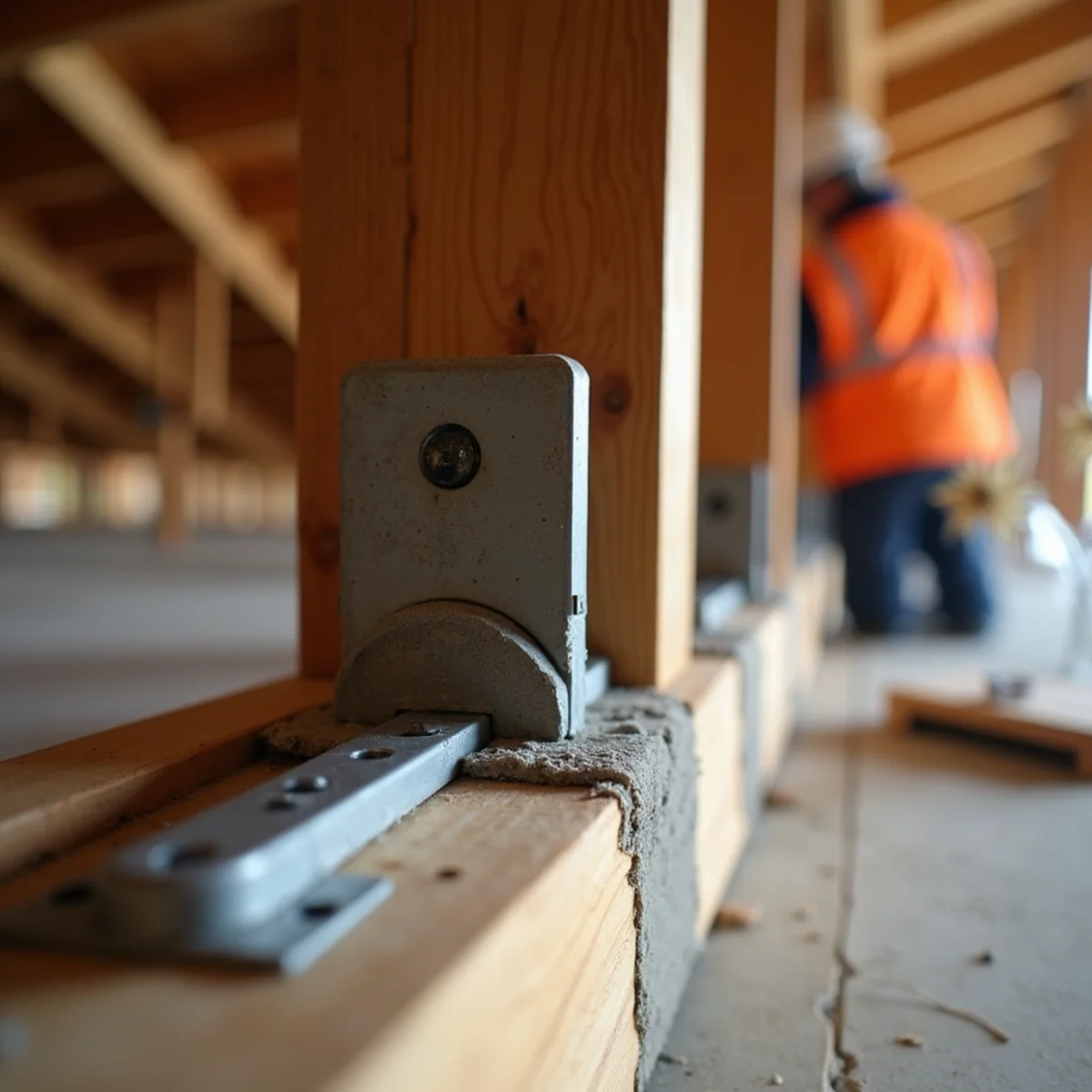
This is often the largest single discount on the entire form. The inspector climbs into your attic to photograph the metal connection securing your roof trusses to the concrete tie-beam or exterior wooden top plate.
- Toenails (Lowest Credit): Trusses attached with 3 or fewer diagonal nails. Offers minimal uplift resistance and receives zero insurance discount.
- Hurricane Clips (Substantial Credit): Metal brackets attached to the truss with at least 3 nails and anchored into the masonry wall, resisting up to 500 lbs of uplift.
- Single Wraps (High Credit): Metal straps that wrap over the top of the truss with at least 3 nails into the truss and securely anchored to the wall.
- Double Wraps (Maximum Credit): Dual opposed metal straps wrapping over each truss side, resisting over 1,000 lbs of uplift force.
Credit Category 4: Secondary Water Resistance (SWR) Self-Adhering Barrier
Secondary Water Resistance (SWR)—commonly known as 'peel-and-stick' underlayment—is a self-adhering polymer-modified bitumen membrane applied directly to the plywood roof sheathing before the shingles or tiles are installed.
If gale-force hurricane winds tear away your outer shingles or tiles, standard organic felt paper shreds instantly, allowing torrential rain into the attic. An SWR membrane seals directly over plywood joints and self-seals around roofing nails, preventing water intrusion even if 100% of the surface shingles blow away.

Florida Wind Mitigation Credit Categories and Typical Premium Savings Impact
Every structural enhancement carries a specific savings tier on the windstorm portion of your Florida policy.
| Inspection Feature | Required Standard for Credit | Typical Savings % on Wind Premium | Average Annual Dollar Savings |
|---|---|---|---|
| Roof Covering Compliance | Permitted under 2001 FBC (March 2002) or later | 10% – 15% | $200 – $450 / year |
| Roof Deck Attachment | 8d ring-shank nails at 6in edge spacing (Level C) | 8% – 12% | $150 – $350 / year |
| Roof-to-Wall Connection | Hurricane Clips or Single Wraps (with 3+ nails) | 25% – 45% | $600 – $1,400 / year |
| Secondary Water Resistance | Self-adhering modified bitumen direct to deck (SWR) | 6% – 10% | $120 – $300 / year |
| Roof Geometry (Hip Roof) | Hip roof profile on at least 90% of perimeter | 25% – 40% | $500 – $1,200 / year |
| Opening Protection (Windows/Doors) | Impact-rated shutters or glass on ALL openings | 15% – 25% | $350 – $800 / year |
Roof Geometry: Why Hip Roofs Receive Substantially Higher Discounts
One structural element you cannot easily change is roof geometry. Hip roofs—which slope down toward walls on all four sides like a pyramid—perform drastically better in wind tunnel tests than gable roofs, which present flat, vertical walls that catch wind.
If your home qualifies as a Hip roof (defined as having no more than 10% of total roof perimeter composed of gable ends), insurers grant an automatic 25% to 40% discount on wind premiums, independent of strapping or nail types.